The Principles of Hotel Distribution

Hotel distribution has become complicated. And expensive.

CRS. GDS. OTAs. Wholesalers. Bedbanks. Metasearch. Direct. Loyalty. Corporate rates. Affiliates. APIs. Closed-user groups. AI agents.

And because the ecosystem has become complicated, we have started to confuse the mechanics of distribution with the purpose of distribution.

Distribution is not fundamentally about managing channels. It is not about loading rates. It is not about achieving parity. And it is certainly not about being bookable everywhere.

Those are activities.

The principles of distribution are much simpler. They are the commercial reasons distribution exists in the first place – and they remain true regardless of how technology, intermediaries or customer behaviour change.

FIRST: DISTRIBUTION EXISTS TO CONNECT DEMAND WITH SUPPLY.

A hotel room has no commercial value if the customer who wants it cannot find it and buy it. Distribution exists to create that connection. Its fundamental purpose is to make the hotel’s inventory available to the demand the hotel wants to capture, at the right time, in the right place and under commercially sensible conditions.

Everything else – channels, systems, contracts, connectivity and rate plans – exists to make that happen.

  1. DISTRIBUTION STARTS WITH DEMAND, NOT CHANNELS.

“Should we be on this channel?” is the wrong first question.

The first question is: What demand are we trying to reach?

Where does that demand exist? What does it need? Where does it search? What influences its decision? And where is it willing to transact?

Only once we understand the demand can we decide which routes to market are necessary to reach it.

Distribution should follow demand strategy. It should never replace it.

  1. DISTRIBUTION CANNOT CREATE RELEVANCE.

Being available does not make a hotel desirable.

Distribution can put a hotel in front of a customer, but it cannot compensate for a proposition that does not meet that customer’s needs. If the location, experience, product, price or proposition is not relevant, adding another channel will not solve the problem.

This is where distribution connects directly to all other commercial functions: U

Understand the demand.
Create a relevant proposition.
Make it visible where that demand is looking.
Give the customer an effective route to convert.

Distribution operates across this journey, but it cannot fix a weakness in every part of it.

  1. DISTRIBUTION IS ACCESS TO DEMAND.

A distribution partner should give the hotel something commercially useful.

That might be access to demand the hotel could not efficiently reach itself. It might be geographic reach, a specific customer segment, corporate travel buyers, loyalty members or customers who prefer a particular booking environment.

The question is not simply: “How much business does this channel produce?”

It is: “What demand does this channel give us access to?”

If multiple channels are simply competing for the same customer, more distribution may not mean more demand.

It may simply mean more ways to pay for the demand you already had.

  1. VISIBILITY HAS VALUE – BUT ONLY IF IT REACHES THE RIGHT DEMAND.

Distribution is partly a visibility system.

Hotels participate in marketplaces because those marketplaces aggregate customers. Position, ranking, recommendation, availability and competitiveness can all influence whether a hotel enters the customer’s consideration set.

But visibility itself is not the objective. Visibility to the wrong customer has little value. And paying for greater visibility without understanding what incremental demand it generates can simply increase the cost of acquiring the same customer.

The objective is not maximum visibility. It is relevant visibility.

  1. A BOOKING IS NOT THE SAME AS VALUABLE DEMAND.

Two bookings for the same room at the same selling price can have very different commercial value.

One may arrive directly with a low acquisition cost and a customer relationship the hotel owns. Another may carry commission, wholesale margin, marketing costs, loyalty discounts or other acquisition costs. Distribution therefore cannot be evaluated purely on topline revenue.

Hotels need to understand what demand costs to acquire, what conditions accompany it, what customer relationship remains after the transaction – and whether the channel is genuinely incremental.

The objective is not simply more bookings. It is more valuable demand.

  1. EVERY RATE HAS A DESTINATION – AND SOMETIMES MORE THAN ONE.

Hotels like to think in channel boxes. The customer does not.

A rate provided to a wholesaler may travel through bedbanks, affiliates, travel agencies, loyalty programmes, banks or other intermediaries before eventually reaching the customer.

The distinction between B2B and B2C is blurred. Once inventory enters the distribution ecosystem, hotels need to understand not only who they contracted with, but also where that inventory is allowed to go.

A distribution decision is therefore not complete when a rate is loaded. It is complete when the hotel understands where that rate can ultimately appear.

  1. PRICE IS PART OF THE PRODUCT THE CUSTOMER SEES.

Hotels often separate brand, marketing and pricing decisions internally. Customers do not.

A customer seeing one price on the hotel website and another somewhere else does not experience this as a Revenue Management issue or a wholesale contracting issue.

They experience it as part of the hotel.

Price affects trust, perceived value and the decision to book. That means distribution decisions can become brand decisions – and rate leakage can become a customer experience problem.

  1. DIRECT IS A ROUTE TO MARKET, NOT THE STRATEGY.

“Grow direct” sounds like a strategy. It isn’t.

Direct can provide lower acquisition costs, stronger customer ownership and greater control of the booking journey. Those are important advantages.

But customers will not necessarily book direct simply because the hotel wants them to. The hotel still needs to earn the booking through relevance, visibility, value and ease of conversion.

The objective should therefore not be to eliminate intermediaries. It should be to understand when the hotel needs an intermediary, what value that intermediary provides and what that access costs.

Hotels have spent years framing distribution as direct versus third party. But that distinction is becoming less useful.

The company that creates the demand, the company that processes the transaction, and the company that builds the longer-term customer relationship do not necessarily have to be the same company anymore.

A guest might discover a hotel through an OTA, be influenced by social media or AI, book through another intermediary, and still become a highly valuable repeat customer of the hotel.

Equally, a guest might book directly after being acquired through expensive paid media – making the “direct” booking considerably less direct, and potentially less profitable, than the booking source suggests.

So perhaps the better question isn’t: “How do we get more guests to book direct?”

It is: “Who creates the demand, who converts it, what does that cost us – and who owns the customer relationship afterwards?”

Direct remains an important route to market. But it is a route, not the objective. The objective is to acquire the right demand at the right cost, make conversion as effective as possible, and create a guest relationship whose value extends beyond the first transaction.

Because in an increasingly interconnected distribution ecosystem, who takes the booking may matter less than who creates – and ultimately retains – the customer value.

  1. MORE DISTRIBUTION DOES NOT AUTOMATICALLY MEAN MORE DEMAND.

Being bookable in more places increases theoretical reach. It does not necessarily increase demand.

If ten channels reach the same customer, the hotel has not created ten sources of demand. It has created ten possible routes through which the same demand can convert.

Every additional route creates potential benefits – but also complexity, cost and the possibility of unintended redistribution.

Good distribution is therefore not about being everywhere. It is about being where it matters.

  1. DISTRIBUTION IS A COMMERCIAL RESPONSIBILITY.

Revenue Management may manage much of the machinery, but distribution outcomes are created across the commercial organisation.

Marketing influences where demand begins. Sales determines which customers and intermediaries receive access to inventory and under what conditions. Revenue Management controls price, availability, restrictions and channel economics. Digital and E-commerce influence discovery and conversion. Finance helps determine the true economics of acquisition. Leadership decides what kind of demand the business wants to pursue.

Distribution therefore cannot belong to one department.

The better question is not: “Who owns distribution?”

It is: “How do we collectively acquire the most valuable demand?”

The customer does not care about your ‘distribution strategy’.

Customers do not care whether a rate originated in the CRS, through a wholesaler, an OTA, a corporate agreement or a loyalty programme. They care about finding an option that meets their needs, at a price they consider reasonable, through a booking route they trust.

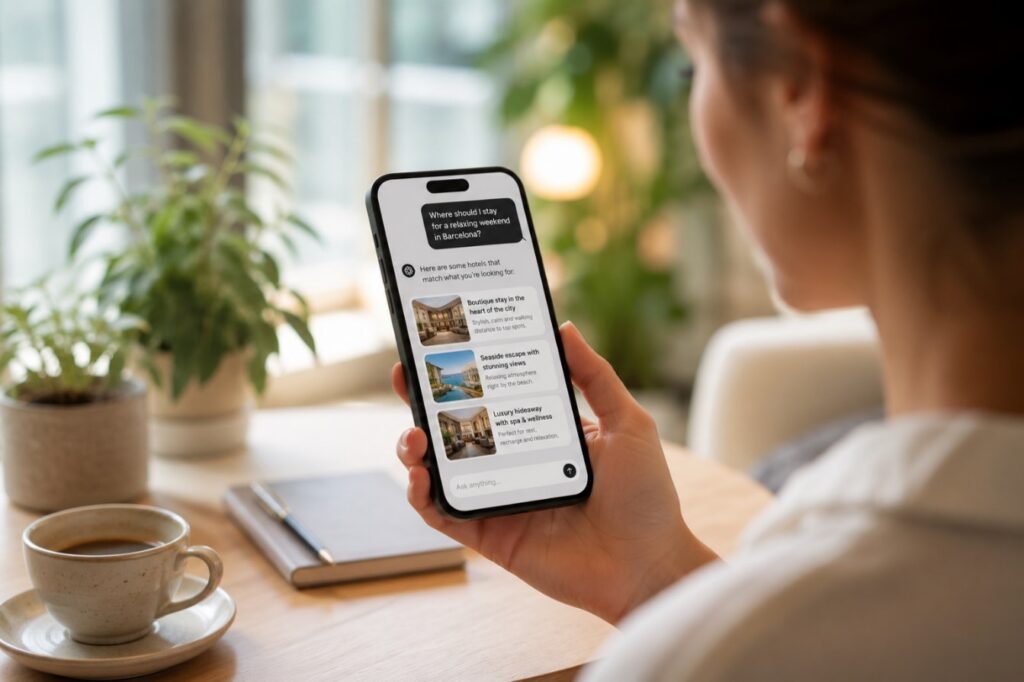
AI will make this even more obvious.

An AI agent asked to find the best hotel or the best available option will not respect the organisational boundaries hotels have created around Revenue, Sales, Marketing or Distribution.

It will search the ecosystem available to it. Which means hotels increasingly need to understand distribution from the outside in.

Search for your own hotel.

Compare it.

Ask AI about it.

Follow your rates.

See what the customer sees.

Because ultimately, distribution is not about where the hotel thinks it sells. It is about where, how and under what conditions the customer can actually buy it.

The simplest way to think about it

Demand → Relevance → Visibility → Conversion → Total Revenue

Demand
Who are we trying to reach?

Relevance
Why should they choose us?

Visibility
Where do we need to be present so they can discover and consider us?

Conversion
What is the most effective and commercially sensible route for them to book?

Total Revenue
Once we acquire the guest, how do we maximise the value of that relationship – across rooms, F&B, spa, experiences and other spend – rather than simply optimise the room booking?

Distribution connects the first four, but its commercial impact reaches the fifth.

Because the objective is not simply to distribute rooms more efficiently. It is to acquire the right guest, at the right cost, and maximise the total value of that guest once acquired.

And that may be the most important first principle of all:

Distribution is not channel management. Distribution is the commercial architecture connecting demand to guest value.

Access Is Not Identity

Independent hotels used to apologize for being independent.

No massive loyalty program. No global sales force. No name recognition the moment a guest lands on a search page. For years, that felt like a disadvantage waiting to be fixed.

Something has shifted. Ask yourself why so many travelers now go out of their way to book something that is not part of a big group.

The case for independence is stronger than it looks

Independent hotels are not built off a template. They carry a story, a design language, a point of view a guest can actually feel. In a market full of interchangeable rooms, that is not a nice-to-have. It is the entire reason a traveler chooses one hotel over another.

Independent hotels also no longer have to gamble on a shoestring budget and hope for the best. CRM, business intelligence, and revenue management tools that used to be priced for the big groups are now genuinely accessible. Providers who never set out to serve this segment specifically are now building offerings that work very well for it.

Then there is discovery. Search itself has changed shape, and AI-driven tools are now deciding what gets surfaced and what gets buried. Big groups often carry so much structure and so many layers of approval that pushing distinctive, AI-findable content becomes its own project. Independent hotels do not carry that weight. They can move today.

What was once a disadvantage is quietly becoming an edge. But an edge only matters if it gets used.

The big groups already saw this coming

Look at how many soft brands have launched in the last five years. Vignette. Unbound Collection. Tribute Portfolio. Unscripted by Hyatt. Every major group now has a version of “keep your identity, just join our network.”

That is not a coincidence. It is an admission. The big groups are telling the market, in their own way, that individuality sells. If it did not, none of these brands would exist.

So the real question is not whether independence has value. The chains already answered that one. The real question is what an owner is actually buying, and what an owner might be quietly giving up, when they say yes to one of these collections.

Access is not the same thing as identity

A soft brand offers something real. Distribution. Loyalty membership. A booking engine with genuine reach. For an independent owner tired of fighting for visibility alone, that is a legitimate, rational trade. Nobody should pretend otherwise.

At a recent investment conference, one soft-brand hotel CEO spoke candidly about the ADR gains since joining a global collection. It is a fair result, and distribution access delivers exactly what it promises.

But it raises a harder question for every owner watching. Did the network create that ADR lift, or did it simply monetize a great product and story faster than building the same reach independently would have? Access can look like an outcome. Sometimes it is actually a shortcut.

Neither answer is wrong. But only one of them is a strategy an owner actually controls.

The flag is infrastructure, not personality

A network can carry a guest to the doorstep. It cannot walk them through it. The moment a guest arrives, distribution stops mattering and identity takes over completely. That part was never for sale, and it never will be.

Yet this is exactly the paragraph most owners skip when the distribution numbers look tempting. A signed soft-brand agreement comes with a fee schedule, a marketing toolkit and a loyalty integration timeline. It rarely comes with a plan for protecting what made the hotel worth flagging in the first place.

So build that plan before signing, not after. A few things worth pinning down early.

Know precisely what carries the network’s name and what carries yours. A brand manual from the collection will define signage, color palettes and service standards. It will not define the story a guest hears at check-in, or the reason a repeat guest chooses this property over the sister property two cities over. That gap belongs to the owner, and nobody else is going to defend it.

Give someone the actual job of guarding it. Not a committee, not “everyone”, one person whose mandate includes protecting brand voice and guest experience independently of what the flag dictates. Without clear ownership, identity drifts quietly, and nobody notices until a guest says the hotel feels the same as the one down the road.

Measure what the network will not measure for you. ADR, RevPAR and loyalty enrollment will show up in every collection report automatically. Guest sentiment about what actually makes the property distinctive will not, unless someone deliberately tracks it.

Revisit the decision on a schedule, not by accident. A soft brand that made sense at signing might not make sense in three years, once the asset, the market and the owner’s ambitions have shifted. Treat the affiliation as a strategy under active management, not a box that got ticked once and filed away.

Before signing up for reach, it is worth asking a different question first. What exactly is this hotel’s story, and who is actually responsible for protecting it once the ink dries.

Where CUBE comes in

This is where we spend a lot of time with owners. Not arguing for or against a soft brand, a full management agreement, or staying fully independent. Every asset carries a different story, every owner carries a different ambition, and every market rewards a different answer. Pretending there is one universal playbook does owners a disservice.

Whatever the decision, what actually helps is carving out an independent brand’s relevant selling proposition, and being crystal clear about who it is actually for. That work does not change based on which network sits behind the front desk. It is what turns a flag, or a fully independent identity, into something a guest can genuinely choose. Guest first. Commercial always.

Before You Invest in Better F&B Data, Invest in the People Looking at It

The hospitality industry loves a dashboard.

Give us more data. Better data. Real-time data. Benchmark data. AI-powered data.

And there is nothing wrong with that.

For years, F&B has operated with far less commercial intelligence than rooms. While Revenue Managers can analyse demand patterns, booking windows, channel mix, pricing and pace, many F&B leaders are still working with yesterday’s revenue, covers and average check.

So yes, we absolutely need better F&B data.

But there is a problem.

Better data does not automatically create better decisions.

And a dashboard does not create a commercial mindset. This is why, at CUBE, we believe the order matters.

Commercial education first. Data second.

Not because data is less important. Because when the data arrives, people need to know what to do with it.

The danger of starting with the tool

Imagine giving an F&B team a new analytics platform.

Suddenly they can see revenue by hour. Average check. Covers. Beverage mix. Item performance. Table duration. Revenue per available seat hour.

Great.

Now what?

If the team has not developed the commercial curiosity to interrogate the numbers, the dashboard quickly becomes another reporting tool.

Revenue is down.

Average check is down.

Beverage sales are below target.

Friday lunch is underperforming.

Interesting. But none of those observations make you more money. The commercial value starts with the next question:

Why?

And then:

What can we do differently?

That is a very different conversation.

Perhaps Friday lunch does not have a revenue problem. It has a demand problem.

Perhaps the restaurant has demand, but not enough visibility.

Perhaps people are finding the restaurant, but the offer is not relevant enough to make them choose it.

Perhaps guests are booking and dining, but the team is missing opportunities to convert demand into higher value through drinks, add-ons, premium choices or another visit during the stay.

The data can point us towards the problem. It still takes commercial thinking to find the opportunity.

Data tells you what happened. It doesn’t always tell you what could have happened.

This is one of the limitations of relying too heavily on historical data.

Your POS can tell you what you sold. It cannot always tell you what you could have sold.

It knows that a guest ordered one glass of wine. It does not know whether the guest would have ordered a bottle if someone had made the right recommendation.

It knows that a table spent $150. It does not know whether they would have stayed for dessert, moved to the bar for another drink, booked brunch the next morning or returned for a special dining event.

It knows how many people came through the door. It does not know how many people never considered coming through the door in the first place.

That is why F&B revenue optimisation cannot begin and end with POS data. We need to look beyond the transaction.

At CUBE, we look at the wider commercial journey through four lenses:

Demand → Visibility → Relevance → Conversion

  • Is there demand for what we are offering?
  • Are we visible where that demand exists?
  • Is the proposition relevant enough for someone to choose us?
  • And once we have their attention – or have them sitting in our restaurant – how effectively do we convert that opportunity into revenue?

The answers will never come from one dashboard alone.

The most valuable question is rarely “What does the data say?”

The more interesting question is: “What are we going to do about it?”

This is where commercial education becomes critical.

Before introducing more sophisticated F&B data tools, we want leaders and teams to understand the commercial levers available to them.

How does demand influence performance?

How can we create demand rather than simply wait for it?

How do pricing, menu engineering, capacity and table duration interact?

What is the relationship between covers, average check and revenue per hour?

How does the server influence revenue?

Where are the revenue moments across the guest journey?

What can Marketing, Revenue, Sales and Operations do together to improve F&B performance?

Because once teams start thinking this way, something interesting happens.

They start asking better questions of the data.

Instead of: “What was our average check last month?”

They ask: “Why is average check higher on Saturday than Friday?”

Instead of: “Which dishes sell the most?”

They ask: “Which dishes contribute most to revenue and margin – and are we giving them enough visibility?”

Instead of: “How many covers did we do?”

They ask: “At what times are we turning demand away, and at what times do we have capacity we could monetise?”

Instead of: “Beverage revenue is down.”

They ask: “Is beverage spend down because of our guest mix, our offer, our pricing – or because we are simply not selling?”

Now the dashboard becomes useful. Because the people looking at it know what they are looking for.

Data should create curiosity, not dependency

There is another risk with becoming too “data-driven”. We start waiting for the data to give us the answer. But sometimes the most valuable commercial opportunities have no historical data.

You may have never offered a pool-day package to local residents.

You may have never sold a five-course anniversary dinner on the beach.

You may have never opened the restaurant at a different time.

You may have never incentivised servers around beverage conversion.

You may have never targeted a specific local audience.

So there is no historical performance to analyse. Someone has to have the commercial instinct to say:

“What if?”

Then test it.

Measure it.

Learn from it.

And optimise it.

That is how new data is created.

The strongest commercial organisations are therefore not simply data-driven. They are commercially driven and data-informed. There is a difference.

Technology is the enabler. Capability is the advantage.

We are strong believers in better F&B data.

Hotels should be able to extract more value from the enormous amount of transactional information sitting inside their POS systems. The right technology can make that data accessible, visual and actionable in ways that traditional reporting simply cannot. But buying the platform is the easy part. The competitive advantage comes from what happens next.

What do your leaders notice?

What questions do they ask?

What assumptions do they challenge?

What experiments do they run?

And how quickly can they turn an insight into action?


This is why CUBE approaches F&B Revenue Optimisation in this order:

Build the commercial mindset.

Understand the revenue levers.

Learn to ask better questions.

Then bring in richer data and better tools.

Because ultimately, the objective is not to create more dashboards. It is to create more commercially capable people. People who can look at a number and see an opportunity. People who understand that data tells us what happened – but commercial thinking helps us decide what happens next.

And when you combine the two?

That is when data starts making you money.

Sales in the Age of AI

Why Are We Still Keeping Our Best Salespeople Behind Desks?


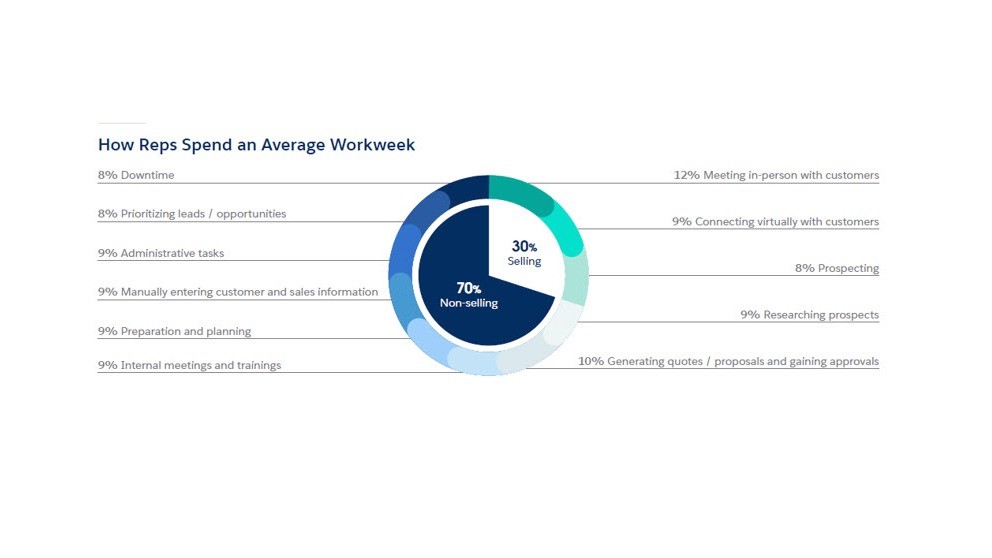
I recently came across the latest Salesforce State of Sales report, and one statistic stopped me in my tracks:

Salespeople spend only 30% of their time selling.

The other 70%? Administration. Internal meetings. Planning. Research. Data entry. Reporting. Quote generation. CRM updates.

And this is in 2026.

For an industry that talks endlessly about productivity, AI, automation and digital transformation, it raises an uncomfortable question:

Why are we still asking some of our most valuable customer-facing people to spend most of their week away from customers?

At the same time, something else has changed dramatically.

Today’s customers often know a surprising amount about your company before the first conversation even happens. They have explored your website, read reviews, compared alternatives, searched social media, asked AI tools for recommendations and, in many cases, already formed an opinion before speaking to a salesperson.

The role of sales is no longer to be the primary source of information.

The role of sales is to provide context, insight, relevance, confidence and trust.

Yet many sales teams remain trapped in processes designed for a different era.

They are still gathering information that already exists. Still creating reports few people read. Still manually updating systems that should update themselves. Still spending more time preparing for conversations than actually having them.

AI should not simply make salespeople more efficient administrators.

It should make them more present salespeople.

Imagine if sales teams spent less time building reports and more time understanding customer challenges.

Less time entering data and more time strengthening relationships.

Less time searching for answers and more time asking better questions.

Because in a world where information is increasingly available to everyone, the true value of sales becomes distinctly human.

  • Curiosity.
  • Empathy.
  • Commercial judgement.
  • The ability to connect problems with solutions.
  • The ability to create relevance.
  • The ability to build trust.

The future of sales is not about replacing people.

It is about removing everything that prevents salespeople from doing what only people can do.

The real opportunity is not to make sales teams work faster.

It is to give them their time back.

Perhaps the most important KPI for sales leadership in the AI era is no longer activity, reports or CRM completion rates.

It may simply be this:

How much time are your salespeople actually spending with customers?

Sales in the age of AI is not about more technology.

It is about creating more space for meaningful human interaction.

The organisations that understand this first will build stronger relationships, create greater relevance and, ultimately, win more business.

AI Visibility Starts With a Problem Hotels Don’t Want to Talk About.

Everyone is talking about AI visibility.


“How do we appear in AI search?”
“How do we rank in generative results?”
“How do we become more discoverable?”

But very few are willing to address the uncomfortable truth behind it.

Most hotels are trying to solve an AI problem with marketing tactics, when the real issue runs far deeper.

Because AI visibility does not start with SEO.


It starts with clarity.

And clarity is something many hotel organisations struggle with.

Not because they lack ambition, but because the fundamentals required for modern visibility are difficult, organisationally uncomfortable and, in many cases, have been ignored for years.

AI does not reward hotels for sounding luxurious.

It rewards relevance.

And relevance begins with a clear understanding of:

  • Who you are.
  • Who you are for.
  • Why guests should care.
  • What makes your experience genuinely relevant.
  • How consistently that story is communicated across every touchpoint.

This is where the industry has a problem.

Many hotels still operate with fragmented positioning, generic messaging and disconnected content ecosystems.

The website says one thing.

OTAs say another.

Social media says something else.

The booking engine barely says anything at all.

Food & Beverage, Spa, Experiences and Rooms are often marketed independently—if they are marketed at all.

Internally, it becomes even more fragmented.

Marketing owns the content.

Revenue owns pricing.

Operations own the experience.

Sales own relationships.

Technology owns systems.

But nobody truly owns the guest narrative from beginning to end.

And AI notices that inconsistency immediately.

The reality is that AI visibility is not simply a digital marketing challenge.


It is an organisational challenge.

Because before AI can understand your hotel, the hotel itself needs to understand what it is trying to become.

That requires leadership.

It requires strategic alignment.

It requires planning.

It requires guest-centric thinking.

It requires operational relevance.

It requires commercial clarity.

And it requires content ecosystems designed around guest intent rather than internal departments.

The hotels that will win visibility in the AI era are unlikely to be those producing the most content.

They will be the ones producing the clearest signals.

Signals that consistently tell the market:

  • Who they are.
  • Who they are relevant for.
  • Why they deserve attention.

That consistency must exist across every stage of the guest journey.

FIND → CHOOSE → BOOK → STAY → GROW

The guest journey is not dead. It has simply evolved.

AI increasingly connects signals across channels, platforms, reviews, structured content, guest behaviour and every digital touchpoint.

Visibility is no longer about isolated campaigns.

It is about ecosystem coherence.

This is where many hotels face another difficult reality.

You cannot automate strategic clarity.

You cannot use AI to compensate for weak positioning.

You cannot optimise your way out of generic storytelling.

And you cannot expect discoverability if your content sounds identical to everyone else in your market.

The irony is that hospitality already possesses what AI ultimately values most:


Authentic human experiences.

Yet too many hotels continue to describe those experiences using the same interchangeable language.

Luxury.

Personalised.

Unforgettable.

World-class.

The future of visibility belongs to hotels that are brave enough to become specific.

Specific about the guest.

Specific about the experience.

Specific about the emotional value they create.

Specific about why they matter.

Because AI visibility is not a technology race.


It is a relevance race.

And relevance starts long before search engines, prompts or algorithms.

It starts with the fundamentals many organisations still avoid addressing.

  • Planning.
  • Positioning.
  • Alignment.
  • Guest understanding and relevance.
  • Omnichannel content.
  • Commercial leadership.

Above all, it requires the willingness to break down organisational silos around a shared vision of the guest experience.

The hotels that address these fundamentals today will not only become more visible in AI-driven discovery.

They will become more relevant to the right travellers, more valuable to their owners and, ultimately, more commercially resilient in the years ahead.


Plans are nothing. Planning is everything.

Dwight D. Eisenhower’s famous quote remains as relevant today as it was decades ago.

In hospitality, many organisations invest significant time creating strategic plans, annual budgets and business plans. Yet, despite the effort, many find themselves facing the same challenges year after year: competing priorities, disconnected departments, reactive decision-making and limited progress on the initiatives that matter most.

The problem is rarely the plan itself.

The problem is that the world changes faster than the plan.

Guest behaviour evolves. Distribution shifts. Technology advances. Competitors reposition. New opportunities emerge. Assumptions that felt certain twelve months ago may no longer be true.

This is why planning matters more than plans.

The most effective hotel organisations do not treat strategy as an annual exercise. They create a rhythm that connects long-term ambition with short-term action.

At CUBE, we often encourage leadership teams to think across four horizons:

10 Years: Vision – “Where are we going?”
What do we want to be known for? What role do we want to play in our market? What will make us relevant and successful in the future?

3 Years: Direction – “What capabilities must we build?”
What capabilities must we build to achieve that vision? What needs to be fundamentally different from today?

1 Year: Priorities – “What matters most now?”
What are the few initiatives that deserve our focus right now? Not twenty priorities. Usually three to five.

90 Days: Action – “What are we doing next?”
What specific actions will move us closer to our goals in the next quarter? How do we know if we are making progress? What KPIs matter?

The real value emerges when these horizons are connected.

Too often, departments create their own priorities in isolation. Marketing has one agenda. Sales has another. Operations is focused elsewhere. Revenue Management is solving different challenges. Everyone is busy, but not always moving in the same direction.

Strategic planning should create alignment, not just documents.

It should help leadership teams make better choices, challenge assumptions, focus resources and create clarity around what matters most.

Most importantly, it should create a culture of learning and rhythm. The strongest organisations continuously ask:

  • What have we learned?
  • What assumptions have changed?
  • What should we stop doing?
  • What should we start doing?
  • What deserves greater focus?

In an industry facing unprecedented change, the organisations that succeed will not necessarily be those with the best plans. They will be those with the clearest direction, the strongest alignment and the discipline to adapt while keeping sight of their long-term ambition.

After all, plans may become outdated.

Planning never does.

***

At CUBE, we have revamped our signature CUBE Compass training in strategic clarity and planning: CUBE LEARNING – cube

Planning is not about predicting the future. It is about preparing your organisation for it. If you would like to explore how greater clarity, alignment and focus could strengthen your organisation’s journey, we would welcome an informal conversation.

Categories