Sales in the Age of AI
Why Are We Still Keeping Our Best Salespeople Behind Desks?
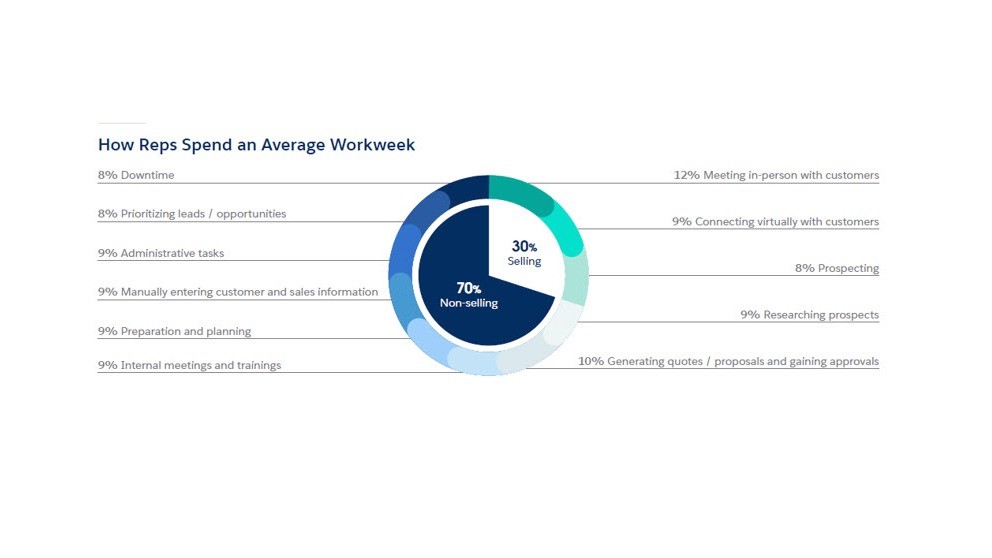
I recently came across the latest Salesforce State of Sales report, and one statistic stopped me in my tracks:
Salespeople spend only 30% of their time selling.
The other 70%? Administration. Internal meetings. Planning. Research. Data entry. Reporting. Quote generation. CRM updates.
And this is in 2026.
For an industry that talks endlessly about productivity, AI, automation and digital transformation, it raises an uncomfortable question:
Why are we still asking some of our most valuable customer-facing people to spend most of their week away from customers?
At the same time, something else has changed dramatically.
Today’s customers often know a surprising amount about your company before the first conversation even happens. They have explored your website, read reviews, compared alternatives, searched social media, asked AI tools for recommendations and, in many cases, already formed an opinion before speaking to a salesperson.
The role of sales is no longer to be the primary source of information.
The role of sales is to provide context, insight, relevance, confidence and trust.
Yet many sales teams remain trapped in processes designed for a different era.
They are still gathering information that already exists. Still creating reports few people read. Still manually updating systems that should update themselves. Still spending more time preparing for conversations than actually having them.
AI should not simply make salespeople more efficient administrators.
It should make them more present salespeople.
Imagine if sales teams spent less time building reports and more time understanding customer challenges.
Less time entering data and more time strengthening relationships.
Less time searching for answers and more time asking better questions.
Because in a world where information is increasingly available to everyone, the true value of sales becomes distinctly human.
- Curiosity.
- Empathy.
- Commercial judgement.
- The ability to connect problems with solutions.
- The ability to create relevance.
- The ability to build trust.
The future of sales is not about replacing people.
It is about removing everything that prevents salespeople from doing what only people can do.
The real opportunity is not to make sales teams work faster.
It is to give them their time back.
Perhaps the most important KPI for sales leadership in the AI era is no longer activity, reports or CRM completion rates.
It may simply be this:
How much time are your salespeople actually spending with customers?
Sales in the age of AI is not about more technology.
It is about creating more space for meaningful human interaction.
The organisations that understand this first will build stronger relationships, create greater relevance and, ultimately, win more business.