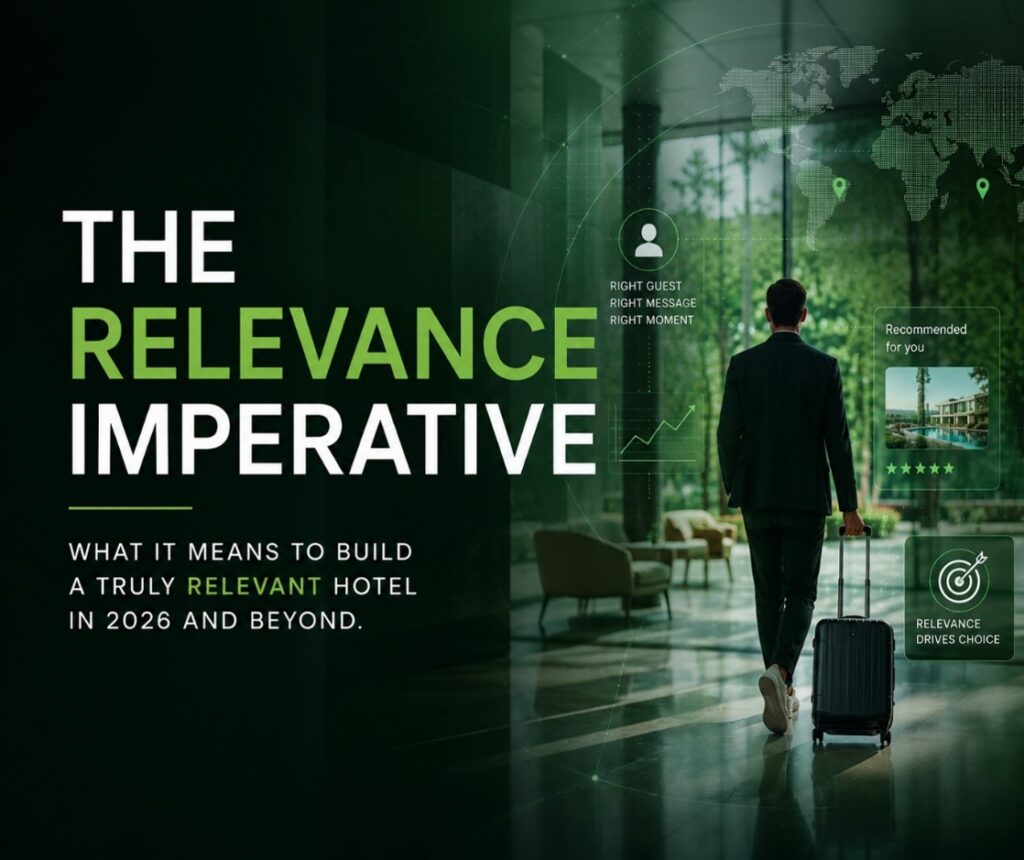
What It Means to Build a Truly Relevant Hotel in 2026 and Beyond
There is a phrase I find myself repeating to hotel teams more than any other.
“You know your hotel inside out.”
It is usually said as a compliment. And it is meant as one.
But increasingly, I follow it with a question that tends to land quietly in the room.
“What if that is exactly the problem?”
Because knowing your hotel inside out, literally, is the default orientation of almost every hospitality organisation on the planet. You know your rooms. Your facilities. Your staff. Your history. Your brand values. Your comp set. Your RevPAR. Your review score.
You know, in extraordinary detail, what you are.
The question the next era of hospitality is asking is different.
Do you know what you are for?
Not for everyone. For the right traveller. At the right moment. Expressed in ways that the platforms, algorithms and AI tools shaping discovery can actually work with.
This article brings together the thinking developed throughout The Hospitality Relevance Series, exploring how hospitality must evolve from an inside-out perspective to an outside-in approach centred on the traveller. If you would like to explore the complete series, the individual articles remain available on LinkedIn:
- Article 1: Visibility Gets You Seen. Relevance Gets You Chosen.
- Article 2: When AI Recommends Three Hotels, Are You One of Them?
- Article 3: When Algorithms Shape Every Booking Decision, Being Listed Is No Longer Enough.
- Article 4: Your Guests Have Already Written Your Best Marketing. You Just Have Not Used It Yet.
That shift from inside-out to outside-in is, I would argue, the single most important strategic reorientation available to hospitality leaders right now.
The outside-in reframe
Here is a practical thought experiment worth trying.
Open your hotel website. Read the homepage copy. Then open your last fifty guest reviews and read those.
In most cases, you will find two very different conversations happening in parallel.
- Your website is talking about what you offer.
- Your guests are talking about how it made them feel.
- Your website is describing the facilities.
- Your guests are describing the moments.
- Your website is using words like timeless, curated and world-class.
- Your guests are using words like warm, specific and genuinely surprising.
Neither is wrong. But only one of them sounds like something a future traveller, or an AI tool, would trust.
The most forward-thinking hospitality organisations are now designing their operations from the guest journey backward. That is a significant structural insight. It means the outside-in shift is not a marketing exercise.
It is a leadership one.
71% of consumers expect companies to deliver personalised interactions, and 76% get frustrated when this does not happen. Those numbers are not about technology. They are about orientation. About whether an organisation is genuinely structured around the traveller it is trying to serve, or around the product it is trying to sell.
The hotels winning in 2026 are not necessarily the ones with the biggest budgets or the most sophisticated technology. They are the ones that have made a genuine, structural commitment to seeing themselves the way their guests see them.
What a truly relevant hotel looks like
Relevance is not a campaign. It is not a rebrand. It is not a new OTA strategy.
It is a way of operating.
- A relevant hotel knows which travellers it is genuinely right for and communicates that clearly and consistently across every channel and touchpoint.
- A relevant hotel does not just have attributes. It has articulated them, structured them and expressed them in language that both travellers and the platforms connecting them can understand and act on.
- A relevant hotel treats guest reviews not as a report card but as a content library, a market research database and a relevance signal, updating its own language and positioning in response to what guests consistently say about it.
- A relevant hotel understands that being found by the right algorithm and being chosen by the right traveller are increasingly the same challenge, requiring the same answer: clarity, consistency and genuine specificity about what makes this property right for this person.
When every experience feels relevant and a property genuinely anticipates guest needs, loyalty becomes a natural outcome. That is especially critical in a market where competition is fierce, online reviews are influential and choosing a different option costs practically nothing for the guest.
Companies that prioritise personalisation generate 40% more revenue than those that do not. That gap will widen, not narrow, as AI-driven discovery becomes the norm rather than the exception.
The opportunity inside that observation is enormous.
A tangible action list for hospitality leaders
These are not abstract principles. They are decisions that can be made this week.
Conduct an outside-in audit of your content.
Read your website, your OTA listings and your top fifty reviews as if you are the traveller, not the hotelier. Where does the gap between how you describe yourself and how guests describe you feel widest? That gap is your starting point.
Map your attributes with specificity.
Not just the facilities you have, but the qualities that make them distinctive. Not “rooftop bar” but “rooftop bar with uninterrupted city views and a drinks menu built around local producers.” Specificity is what AI systems—and travellers—find useful.
Let guest language lead your marketing.
Identify the words and phrases that appear repeatedly in your reviews and are absent from your own copy. Those words belong in your positioning. They are trusted, human and already proven to resonate.
Test your discoverability as a traveller would.
Describe your ideal guest in natural language and ask an AI tool to recommend a hotel matching that profile in your destination. If your hotel does not appear, you now have a specific problem to solve rather than a vague concern to defer.
Build relevance into how decisions are made, not just what you communicate.
The outside-in shift is not a content project. It requires commercial teams, operations teams and marketing teams to share a common picture of who the hotel is genuinely right for and to make decisions in light of that picture consistently.
Where to start – and how CUBE can help
The shift from inside-out to outside-in is not a project with a defined end point. It is a way of operating that requires ongoing commitment, the right questions and, often, a fresh pair of eyes.
At CUBE, this is exactly where we help.
Every recommendation, workshop and strategy we develop starts with the guest journey and the factors that influence guest choice, connecting those insights directly to commercial performance. Guest experience and commercial success are not separate conversations. A hotel that is genuinely understood by the right traveller, discovered at the right moment and experienced as relevant from first search to final review is a hotel that converts better, retains guests longer and delivers stronger commercial results.
Making that shift also requires structured, machine-readable content that AI platforms and recommendation engines can understand.
This is where our partnership with RightRooms adds something unique.
RightRooms uncovers and verifies hundreds of detailed hotel attributes that go far beyond traditional marketing copy, creating structured content that enables AI systems to confidently match the right hotel with the right traveller.
Together, CUBE and RightRooms combine strategic commercial thinking with structured content that improves discoverability, relevance and ultimately business performance.
If this article has prompted a conversation worth having within your organisation, we would be delighted to continue that conversation with you.